Crafting is the beating heart of Minecraft. Every sword swung, every chandelier hung, and every nether portal lit traces back to one screen: the crafting grid. For new players in 2026, the system can feel overwhelming, with hundreds of recipes, multiple workstations, and version differences between Java and Bedrock. But once the logic clicks, it stops being a chore and starts feeling like second nature. This guide breaks down how to craft in Minecraft from the ground up, covering recipes, shortcuts, and the mistakes that quietly waste hours of playtime.
Table of Contents
ToggleKey Takeaways
- Master the crafting system by understanding that the 2×2 inventory grid handles basic recipes while the crafting table unlocks the full 3×3 grid needed for advanced Minecraft items.
- Essential early-game recipes include wooden pickaxes, swords, armor, bread, and torches—memorizing these core recipes is the difference between surviving and thriving in your first 10 hours.
- The Crafter block (introduced in 1.21) automates repetitive crafting tasks like arrows and rockets, significantly boosting your building speed when paired with hoppers and redstone.
- Common crafting mistakes like misplacing shaped recipes, repairing items too often on anvils, and wasting wood on sticks compound into hours of lost playtime over a full world.
- Organize your base strategically by keeping your crafting table, furnace, chest, and smithing table within two blocks of each other, and use hotbar slots 1–3 for tools to maximize efficiency.
- Master crafting in Minecraft by learning grid logic, stocking the right materials, and leveraging automation tools once early-game progression is complete.
Understanding the Crafting System in Minecraft
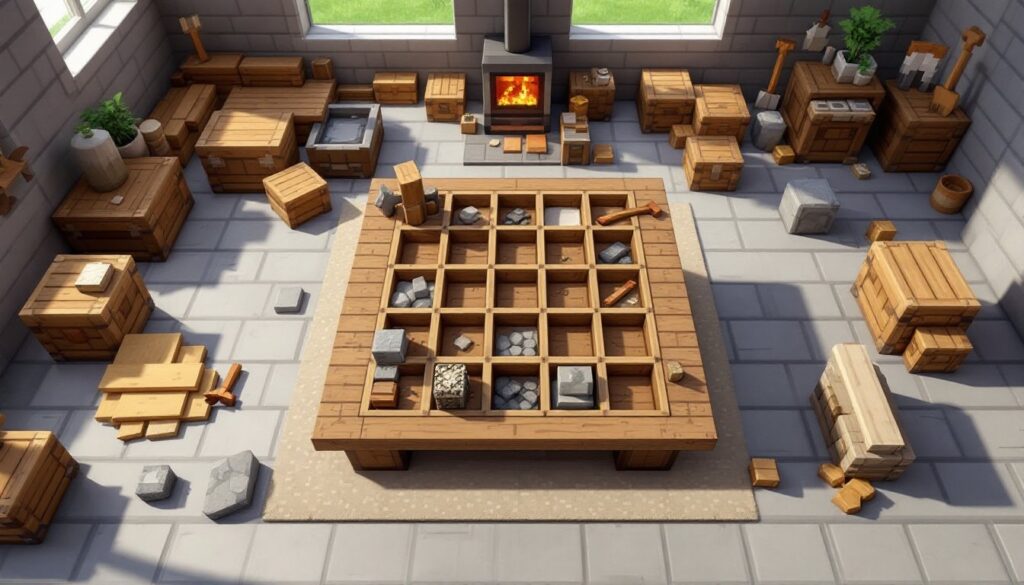
Minecraft’s crafting system is grid-based. The player’s inventory offers a 2×2 grid for basic recipes, while the crafting table unlocks the full 3×3 grid required for almost every meaningful item in the game.
Recipes are either shaped (ingredients must sit in a specific pattern) or shapeless (order doesn’t matter, like dyes or mushroom stew). Since the 1.12 update, the Recipe Book has lived in the top-left corner of the crafting UI, surfacing recipes the player has the ingredients for.
Version matters too. Old-school players remember Minecraft 1.8 for adding spectator mode and overhauling combat, but the 1.21 Tricky Trials update introduced the Crafter block, the first real automation tool for the craft minecraft minecraft minecraft loop. It works on Java, Bedrock, PS5, Xbox, Switch, and Mobile.
Setting Up Your Crafting Table and Inventory
The minecraft crafting table is the first real milestone. Players punch a tree, collect logs, convert one log into four planks in the 2×2 inventory grid, then arrange four planks in a square to produce the table itself.
Placement matters more than beginners think. A well-organized base usually keeps the crafting table within two blocks of a furnace, chest, and smithing table so the player isn’t sprinting across the room mid-build. Some players go further and design dedicated crafting rooms inside their medieval Minecraft builds so function meets aesthetics.
Inventory hygiene is just as critical. Hotbar slots 1–3 should be reserved for tools, 4–6 for combat gear, and 7–9 for blocks. Shift-clicking moves stacks instantly between inventory and table, which saves a surprising amount of time on long sessions.
Essential Recipes Every Player Should Know
Memorizing a handful of core recipes is the difference between scraping by and thriving. The list below covers what most players actually need in their first 10 hours of survival.
Tools, Weapons, and Armor
- Wooden Pickaxe: 3 planks across the top row, 2 sticks down the middle column.
- Sword: 2 planks/ingots stacked vertically with a stick beneath.
- Shield: 6 planks in a Y-shape with 1 iron ingot in the center-top.
- Bow: 3 sticks and 3 strings in a diagonal pattern. For a deeper breakdown of damage, enchants, and trick shots, the complete bow guide covers every angle.
- Armor: Helmet uses 5 ingots (top row + sides of middle row), chestplate uses 8, leggings 7, boots 4.
Iron gear remains the sweet spot for early-to-mid game. Diamond is still king for durability, but Netherite, crafted by combining a diamond tool with a netherite ingot at a smithing table, is the endgame target.
Food, Potions, and Utility Items
- Bread: 3 wheat in a horizontal row.
- Cake: 3 milk buckets, 2 sugar, 1 egg, 3 wheat.
- Awkward Potion: Nether wart in a water bottle at a brewing stand, then add modifiers like blaze powder for Strength or glistering melon for Healing.
- Ladders: 7 sticks in an H-pattern produce 3 ladders. Vertical builds get a lot easier once players nail crafting a ladder properly.
- Lighting: Torches are the default, but layered glowstone setups and decorative chandelier designs elevate any interior.
Advanced Crafting Tips to Speed Up Your Progress
Once the basics are locked in, efficiency becomes the new game. A few habits separate veterans from weekend builders.
- Use the Crafter block. Introduced in 1.21, it pairs with hoppers and redstone to automate repetitive recipes like rockets, arrows, or sticks. A solid auto-craft tutorial walks through the redstone wiring step by step.
- Master the anvil. Renaming, repairing, and combining enchanted gear all run through it. The anvil recipe guide lays out XP costs that catch most players off guard.
- Batch your smelting. Stack 64 raw items in a furnace before stepping away to mine, idle furnaces are wasted minutes.
- Tag your chests. Place an item frame on each chest with the contents inside. Sorting saves hours over a long world.
- Try modded play. Vanilla recipes get stale around the 100-hour mark. Pack overhauls like the better Minecraft modpack add hundreds of new crafting trees without breaking the base game’s feel.
Multiplayer crafting also scales differently. On a private Minecraft Realms server, splitting roles, one player mines, one farms, one builds, turns crafting from a solo grind into an assembly line.
Common Crafting Mistakes and How to Avoid Them
Even experienced players make these. Watch for them.
- Wasting wood on sticks. Two planks make four sticks. Crafting one stick at a time burns through logs fast.
- Skipping the smithing template. Netherite upgrades in 1.20+ require a Netherite Upgrade Smithing Template, found in bastion remnants. Forgetting this strands players with a stack of unused netherite ingots, a frustration Game Rant has flagged in patch coverage repeatedly.
- Misplacing recipes in the 3×3 grid. Shaped recipes care about position. A pickaxe pattern shifted one column to the right produces nothing.
- Repairing too often on an anvil. Each repair raises the XP cost exponentially until the item becomes “Too Expensive.” Use Mending enchantments instead.
- Ignoring the Recipe Book filter. Toggling “craftable only” hides clutter and surfaces what the inventory can actually produce right now. Walkthrough sites like Game8 keep updated recipe lists for every major patch.
Most of these mistakes cost minutes individually but compound into hours across a full world.
Final Thoughts
Crafting in Minecraft rewards players who treat it like a system, not a chore. Learn the grid logic, stock the right materials, and lean on automation once the early-game grind is behind. The 2026 sandbox is deeper than ever, and the players who master crafting are the ones building castles while everyone else is still punching trees.